Author: Servants of God

  • Overcoming Prejudice

    Overcoming Prejudice

    Prejudice is defined as showing partiality, favoritism, or making unjust, pre-assigned judgments based on appearance, race, or social status, which is condemned as sin. God cares about people regardless of their ethnicity, nationality, and social status (Deuteronomy 10:17-19). “God does not show favoritism but accepts from every nation the one who fears him and does what is right” (Acts 10:34-35).

    How to overcome prejudice?
    Overcoming prejudice involves recognizing that all people are created in God’s image, repenting of partiality, and intentionally loving others with humility and service. Key steps include renewing the mind (Romans 12:2), treating everyone as equals at the cross (Galatians 3:28), and seeing people as God does—by the heart, not by appearance (1 Samuel 16:7).

    Matthew 22:1-14, the Parable of the Wedding Feast, illustrates the kingdom of heaven as a royal banquet where God (the King) invites people to celebrate His Son (Jesus). He invited some people to the feast. When it was ready, the king sent his servants to tell the people to come. But they refused to come to the king’s feast. “Then the king sent some more servants. He said to them, ‘I have already invited the people. So tell them that my feast is ready. I have killed my best bulls and calves to be eaten. Everything is ready. Come to the wedding feast.’ “But when the servants told the people to come, they refused to listen. They all went to do other things. One went to work in his field, and another went to his business. Some of the other people grabbed the servants, beat them, and killed them. The king was very angry. He sent his army to kill those who murdered his servants. And the army burned their city. “After that, the king said to his servants, ‘The wedding feast is ready. I invited those people, but they were not good enough to come to my feast. So go to the street corners and invite everyone you see. Tell them to come to my feast.’ So the servants went into the streets. They gathered all the people they could find, good and bad alike, and brought them to where the wedding feast was ready. And the place was filled with guests. “When the king came in to meet the guests, he saw a man there who was not dressed in the right clothes for a wedding. The king said, ‘Friend, how were you allowed to come in here? You are not wearing the right clothes.’ But the man said nothing. So the king told some servants, ‘Tie this man’s hands and feet. Throw him out into the darkness, where people are crying and grinding their teeth with pain.’ “Yes, many people are invited. But only a few are chosen.”

    Colossians 3:5-11 says put everything evil out of your life: sexual sin, doing anything immoral, letting sinful thoughts control you, and wanting wrong things. And don’t keep wanting more and more for yourself, which is the same as worshipping a false god. God will show his anger against those who don’t obey him, because they do these evil things. You also did these things in the past, when you lived like them. But now put these things out of your life: anger, losing your temper, doing or saying things to hurt others, and saying shameful things. Don’t lie to each other. You have taken off those old clothes—the person you once were and the bad things you did then. Now you are wearing a new life, a life that is new every day. You are growing in your understanding of the one who made you. You are becoming more and more like him. In this new life, it doesn’t matter if you are a Greek or a Jew, circumcised or not. It doesn’t matter if you speak a different language or even if you are a Scythian. It doesn’t matter if you are a slave or free. Christ is all that matters, and he is in all of you.

    Galatians 3:26-29 teaches that you were all baptized into Christ, and so you were all clothed with Christ. This shows that you are all children of God through faith in Christ Jesus. Now, in Christ, it doesn’t matter if you are a Jew or a Greek, a slave or free, male or female. You are all the same in Christ Jesus. You belong to Christ, so you are Abraham’s descendants. You get all of God’s blessings because of the promise that God made to Abraham.


  • Celebrating the birth/adoption of a child

    Celebrating the birth/adoption of a child

    Celebrating a birthday involves marking another year of life with loved ones and creating memorable experiences with friends or family. Adoption is a profound act of grace, mirroring how God brings believers into His family as children with full inheritance rights.

    Birthdays are days of rejoicing, and Psalm 118:24 captures that joyful spirit. Every day is a gift from God, and this verse reminds us to be glad in the moment and to appreciate the life He has given us.

    Psalm 100 is a vibrant hymn of praise and thanksgiving, calling the entire world to worship God with joy, gratitude, and gladness. Earth, sing to the Lord! Be happy as you serve the Lord! Come before him with happy songs! Know that the Lord is God. He made us, and we belong to him. We are his people, the sheep he takes care of. Come through the gates to his temple, giving thanks to him. Enter his courtyards with songs of praise. Honour him and bless his name. The Lord is good! There is no end to his faithful love. We can trust him forever and ever! Happiness is momentary; joy is an excitement for the things of God.

    Luke 18:15-17 highlights Jesus welcoming infants and children, rebuking disciples who tried to stop them, and declaring that the kingdom of God belongs to those with a humble, dependable, and trusting faith like a child.

    John 16:16-22, Jesus states that “After a short time you won’t see me. Then, after another short time, you will see me again.” Some of the followers said to each other, “What does he mean when he says, ‘After a short time you won’t see me. Then after another short time, you will see me again, and what does he mean when he says, ‘Because I am going to the Father’?” They also asked, “What does he mean by ‘a short time’? We don’t understand what he is saying.” Jesus saw that the followers wanted to ask him about this. So he said to them, “Are you asking each other what I meant when I said, ‘After a short time you won’t see me. Then, after another short time, you will see me again? The truth is, you will cry and be sad, but the world will be happy. You will be sad, but then your sadness will change to happiness. “When a woman gives birth to a baby, she has pain, because her time has come. But when her baby is born, she forgets the pain. She forgets because she is so happy that a child has been born into the world. It is the same with you. Now you are sad, but I will see you again, and you will be happy. You will have joy that no one can take away. This passage encourages believers to maintain an eternal perspective, knowing that temporary suffering will produce lasting joy.

    Proverbs 22:6 (“Train up a child in the way he should go; even when he is old he will not depart from it”) is a wisdom literature advising parents to diligently instruct children in godly character, habits, and faith.

  • Experiencing illness

    Experiencing illness

    Sickness is a condition that affects the physical, emotional, and spiritual well-being of individuals. According to Hebrews 12:5-11, illness is permitted as a means of correcting or refining believers, drawing them closer to God.

    Isaiah 41:10 says
    “So do not fear, for I am with you; do not be dismayed, for I am your God. I will strengthen you and help you; I will uphold you with my righteous right hand.” God promises to offer comfort to those who seek Him.

    Psalm 23 describes that the Lord is my shepherd. I will always have everything I need. He gives me green pastures to lie in. He leads me by calm pools of water. He restores my strength. He leads me on the right path to show that He is good. Even if I walk through a valley as dark as the grave, I will not be afraid of any danger, because you are with me. Your rod and staff comfort me. You have prepared a meal for me in front of my enemies. You have welcomed me as an honored guest. My cup is full and spilling over. Your goodness and mercy will be with me all my life and I will live in the Lord’s house a long, long time. So, under divine care, one will never truly lack what is needed and will experience enduring goodness, spiritual protection, and eternal life in God’s presence.

    According to Deuteronomy 31:6, “Be strong and courageous, for the Lord your God goes with you; He will never leave you nor forsake you.” Psalm 41:3 says, “The LORD sustains them on their sickbed and restores them from their bed of illness.”

  • Wise women and foolish women

    Wise women and foolish women

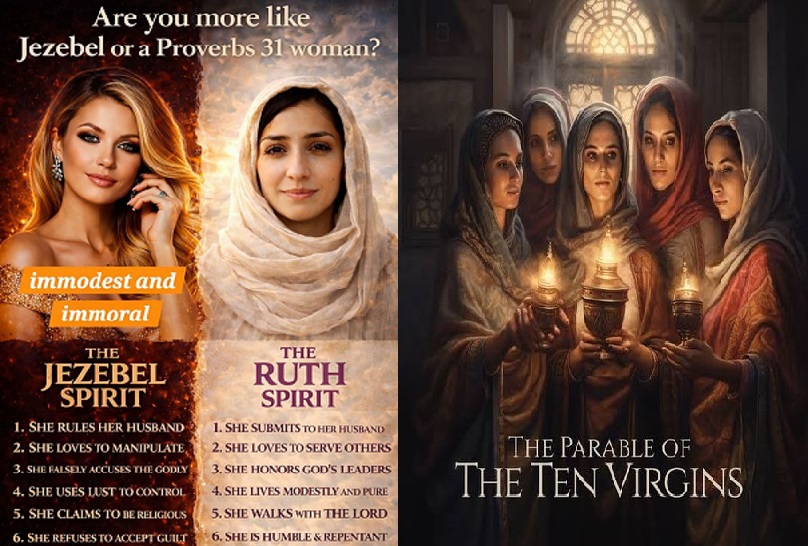
    A wise woman is defined not by intellectual cleverness, but by her foundational “fear of the Lord,” which translates into godly character, skillful stewardship, and active, constructive influence over her home and community. Proverbs 14:1 says the wise woman builds her house, but with her own hands the foolish one tears hers down.

    Matthew 25:1-13 presents the Parable of the Ten Virgins, which teaches readiness for Christ’s return. “At that time, God’s kingdom will be like ten girls who went to wait for the bridegroom. They took their lamps with them. Five of the girls were foolish, and five were wise. The foolish girls took their lamps with them, but they did not take extra oil for the lamps. The wise girls took their lamps and more oil in jars. When the bridegroom was very late, the girls could not keep their eyes open, and they all fell asleep. “At midnight, someone announced, ‘the bridegroom is coming! Come and meet him!’ “Then all the girls woke up. They made their lamps ready. But the foolish girls said to the wise girls, ‘Give us some of your oil. The oil in our lamps is all gone.’ “The wise girls answered, ‘No! The oil we have might not be enough for all of us. But go to those who sell oil and buy some for yourselves.’ “So the foolish girls went to buy oil. While they were gone, the bridegroom came. The ready girls went in with the bridegroom to the wedding feast. Then the door was closed and locked. “Later, the other girls came. They said, ‘Sir, sir! Open the door to let us in.’ “But the bridegroom answered, ‘Certainly not! I don’t even know you.’ “So always be ready. You don’t know the day or the time when the Son of Man will come.”

    Wise Women: Ruth is a Moabite woman who marries a Judean immigrant named Mahlon. Upon his death, she becomes a childless widow who chooses to accompany her mother-in-law, Naomi, to Judah, instead of remaining with her own people. Ruth then became the wife of Boaz, a wealthy kinsman of her former husband, and bore Obed.

    Foolish Women: Jezebel, a Phoenician princess who married King Ahab of Israel, is a notorious biblical figure known for promoting Baal worship, persecuting Yahweh’s prophets (especially Elijah), and orchestrating the murder of Naboth for his vineyard, leading to her own violent death as prophesied. She is a symbol of wickedness, idolatry, and a powerful, manipulative woman.

    Difference between Wise Women and Foolish Women
    The wise woman honours, but the foolish woman humiliates. The wise woman creates peace, but the foolish woman creates war. The wise woman speaks life, but a foolish woman’s tongue is a weapon. The wise woman can admit she’s wrong, but for a foolish woman, pride is more important than her home. The wise woman protects her marriage from gossip and strangers, but a foolish woman lets outsiders run her home.

    According to Proverbs 31:26-27:
    “A wise woman opens her mouth with wisdom, and the teaching of kindness is on her tongue. She looks well to the ways of her household, and does not eat the bread of idleness.”