
Category: Mindful Bible Reads

  • SELF-RIGHTEOUS CHRISTIANITY

    SELF-RIGHTEOUS CHRISTIANITY

    Main Ref: Luke 18:9–14
    Christianity is not about proving that we are better than others; it is about becoming more like Christ. “When being right becomes more important than being like Christ.”

    Luke 18:9 introduces the Parable of the Pharisee and the Tax Collector, which Jesus told to people who trusted in their own righteousness and despised others.

    CAN A CHRISTIAN BECOME SELF-RIGHTEOUS?
    When we hear the word self-righteous, we usually think about someone who is proud, judgmental, and religious. But Jesus gives us a surprising example of a Pharisee and a tax collector in Luke 18, where two men go to the temple to pray.

    The Pharisee proudly thanks God for his moral conduct and religious practices like fasting and tithing. In contrast, the tax collector stands at a distance, humbly beats his breast, and asks God for mercy as a sinner. Here, the Pharisee trusted in himself, but the tax collector trusted in God’s mercy.

    As self-righteous Christians, we can do religious things while becoming spiritually proud. We can know the Bible but not know humility. We can attend church but look down on people. We can serve God but secretly worship ourselves.

    WHAT IS SELF-RIGHTEOUSNESS?
    Self-righteousness is trusting in our own goodness and religious performance instead of depending on God’s grace.

    Look at the Pharisee’s prayer in Luke 18:11, 12: “God, I thank you that I am not like other men . . .” “I am not like them.” “I fast twice a week; I give tithes of all that I get.”

    There is nothing inherently wrong with fasting or giving. But the Pharisee prays proudly in the temple, thanking God that he is morally superior to others and listing his strict religious habits.

    Self-righteousness says: “Look at what I have done” and “I am not like them.” Whereas humility says: “I am not like them” and “Without Jesus, I am nothing.”

    SELF-RIGHTEOUSNESS ALWAYS COMPARES
    The Pharisee needed someone to compare himself with. He looked at the tax collector and thought: “At least I’m not like him.” Sometimes our Christianity becomes a comparison game. “I pray more than him.” “I know more about the Bible than her.” “I have been a Christian longer.” “I serve in ministry.”
    And slowly we stop asking, “Am I becoming like Jesus?” and start asking, “Am I better than them?”

    In Galatians 6:4, Paul says, “Let each one test his own work…” The Christian life is not a competition. We don’t measure ourselves against another Christian. We look at Christ.

    Eg: Imagine two people standing in front of a mirror. One looks at himself and says, “I need to change.” The other looks in a mirror and says, “Look how dirty everyone else is.” That’s what self-righteousness does. It makes us experts at seeing other people’s problems while becoming blind to our own.

    Jesus said: “Why do you see the speck that is in your brother’s eye, but do not notice the log that is in your own eye?” — Matthew 7:3. Jesus isn’t saying we should ignore sin. He is saying: Deal with your own heart first.

    SELF-RIGHTEOUSNESS FORGETS GRACE
    The tax collector stood far away. He wouldn’t even lift his eyes towards heaven. He simply prayed: “God, be merciful to me, a sinner!” — Luke 18:13.

    The Pharisee says: “Look what I’ve done,” and presents his achievements.
    The tax collector says: “Lord, I need mercy,” and presents his brokenness.

    Why did Jesus say the tax collector went home justified?
    Because salvation has never been something we earn by becoming impressive enough for God.
    “For all have sinned and fall short of the glory of God.” — Romans 3:23 and: “For by grace you have been saved through faith… it is the gift of God.” — Ephesians 2:8

    TRUTH WITHOUT LOVE CAN BECOME SELF-RIGHTEOUSNESS
    Humility does not mean saying sin doesn’t matter. Grace does not mean abandoning truth. Jesus never compromised God’s truth. There is an important balance here. Jesus never compromised God’s truth. But he also never used truth as an excuse to treat broken people without compassion. Galatians 6:1 says: “…restore him in a spirit of gentleness.” This means not to destroy or celebrate someone’s failure.

    Eg: Imagine someone falling into a ditch. One person stands above them and says: “How foolish you are!” Another person reaches down and says: “Give me your hand.” Both see the problem. But only one is trying to restore the person. That’s what Christian correction should look like. Truth tells us where the problem is. Love helps us walk out of it.

    RELIGIOUS PERFORMANCE IS NOT THE SAME AS SPIRITUAL TRANSFORMATION
    Religious performances like teaching, fasting, attending church, serving, or reading scripture would not be considered as spiritual transformation if we have pride, bitterness, greed, jealousy, anger, and unforgivingness.

    Jesus warned about people who looked religious on the outside while their hearts were far from God: “These people honor me with their lips, but their hearts are far from me.” — Matthew 15:8

    So we need to ask ourselves:
    Is my Christianity changing my heart? “Am I becoming more loving?”
    “How much of the Bible do I know?” “Am I obeying what I know?”
    “How much do I serve?” “Do I serve with humility?”

    WHAT SHOULD REPLACE SELF-RIGHTEOUSNESS?
    1. Replace comparison with compassion.
    Instead of asking “Why are they like that?” ask “How can I help them?”
    2. Replace condemnation with restoration.
    Instead of enjoying someone’s failure: Pray for their restoration.
    3. Replace pride with gratitude.
    Instead of saying, “Look how good I am,” say: “Thank You, Jesus, for Your grace.”
    4. Replace judgment with self-examination.
    Before asking: “What’s wrong with them?” he asked: “Lord, what’s wrong with me?”
    David prayed: “Search for me, O God, and know my heart . . .” — Psalm 139:23. That is a dangerous prayer for a proud heart—but a beautiful prayer for a disciple.

    THE CROSS — THE CURE FOR SELF-RIGHTEOUSNESS
    The cross destroys our boasting. Why? Because the cross tells us: I could not save myself. Jesus had to save me. Ephesians 2:8–9 says salvation is: “the gift of God… not a result of works, so that no one may boast.” When we remember the cross, we cannot stand before another sinner and say: “I’m better than you.” We can only say: “I am saved by grace.” The ground is level at the cross. We don’t come to Jesus because we were good enough. We come because He is good.

    The goal of Christianity is not: “Look how righteous I am.”
    The goal is: “Look what Jesus has done to me.”
    When someone falls, don’t celebrate, rather ‘pray’ for them.
    When someone sins, don’t forget your own need for grace rather than ‘restore’

    And every morning, remember: “God, be merciful to me, a sinner.” Because the closer we come to the cross, the less we boast about ourselves, and the more we thank Jesus for His grace.

  • DIE TO THE OLD LIFE

    DIE TO THE OLD LIFE

    God did not send Christ to renovate your old life. He calls you to die to the old life and live a new life in Christ.” Galatians 2:20 says, “I have been crucified with Christ; it is no longer I who live, but Christ lives in me…”

    CHRIST DID NOT COME TO MAKE THE OLD YOU BETTER
    Imagine buying an old, damaged house. You clean the rooms, repaint the walls, replace the doors, and you put new furniture inside. From the outside, everything looks beautiful. But underneath the paint, the foundation is still broken. That is how many people approach Christianity.

    They say: “I need Jesus so I can become a better person.” So they try to improve: their behaviour, their relationships, or habits. But Christianity is not fundamentally self-improvement. It is death and resurrection.

    Jesus did not come merely to make the old nature comfortable. He came to give us new life. The Gospel is not “Improve yourself.” The Gospel is “Die to yourself and live in Christ.”

    THE OLD SELF CANNOT BE REFORMED
    Romans 6:6 says, “Knowing this, that our old man was crucified with Him…” Notice the language Paul uses. He doesn’t say: “Our old man was educated.” Or “Our old man was improved.” He says: “Our old man was crucified.”

    The problem is the old nature that lives independently of God. He calls us to surrender that old life.

    RELIGION CAN CLEAN THE OUTSIDE — BUT CHRIST CHANGES THE INSIDE
    This is one of the great dangers of Christianity. A person can become religious without becoming transformed. They can attend church, sing songs, or serve in ministry, yet still live according to the old self. Jesus confronted this kind of religion.

    According to Matthew 23:27, Jesus compared religious people to whitewashed tombs. It is a powerful picture which is beautiful outside but dead inside.

    You can change your appearance without changing your heart. You can change your clothes without changing your character. You can change your environment without changing your desires.

    Only Christ can make us new.

    THE CROSS IS NOT DECORATION — IT IS DEATH
    We often wear the cross. We put the cross on the walls. But the biblical cross means something much deeper. The cross represents death. Jesus died on the cross.

    In Galatians 2:20, Paul says: “I have been crucified with Christ and I no longer live, but Christ lives in me. The life I now live in the body, I live by faith in the Son of God, who loved me and gave himself for me.”

    DYING IS NOT A ONE-TIME EMOTION
    Some people have a powerful experience with God. They pray. They cry. They feel God’s presence. But Christian discipleship is not simply about one emotional moment.

    Jesus said, in Luke 9:23, “If anyone desires to come after Me, let him deny himself, and take up his cross daily, and follow Me.”

    YOU CANNOT LIVE THE NEW LIFE WHILE HOLDING ONTO THE OLD LIFE
    Imagine someone trying to walk forward while constantly looking backward. They will eventually stumble.

    Many Christians seek both worldly and spiritual values. But Christ calls us to something different. In Luke 9:62, Jesus said: “No one, having put his hand to the plough, and looking back, is fit for the kingdom of God.”
    Following Jesus requires direction.

    DYING TO THE OLD SELF MEANS CHRIST BECOMES THE CENTER
    Now return to Galatians 2:20: “It is no longer I who live, but Christ lives in me.”
    Christianity isn’t simply: “I am dead.” It is: “I am dead to the old life so that Christ can live through me.” The Christian life is not an empty life. It is a Christ-filled life.

    ZACCHAEUS — A PICTURE OF A CHANGED LIFE
    In Luke 19:1–10, Zacchaeus encounters Jesus. And something changes. He doesn’t simply say: “Jesus, I feel better now.” His encounter with Christ produces repentance. He says he will give to the poor and repay those he has cheated. This is genuine transformation.

    When Christ enters a person’s life, eventually something begins to look different. Not because the person is trying to impress God, but because Christ is changing the person from within.

    THE RICH YOUNG RULER — A CONTRAST
    Now look at another man in Matthew 19:16–22. The rich young ruler comes to Jesus. He appears religious. He has morality. He has possessions. He has status. But when Jesus asks him to surrender what controls his heart, he walks away. This is because he wanted eternal life without surrendering his old life. He wanted Jesus, but he didn’t want Jesus to become Lord over everything.

    And this is the question every Christian must face: “Is Jesus simply part of my life, or is Jesus Lord of my life?”

    HOW DO WE KNOW THE OLD SELF IS DYING?
    It is not by perfection but by direction.

    A Christian may stumble, may fail, or may even struggle. But there should be a growing desire to obey Christ.

    According to Galatians 5:22–23, the fruit of the Spirit produces love, joy, peace, patience, kindness, goodness, faithfulness, gentleness, and self-control. The evidence of new life isn’t the Bible verses we know, but it is the Holy Spirit that is producing a Christ-like character in us.

    THE OLD LIFE HAS TO GO
    Paul gives us a powerful picture in: Ephesians 4:22–24. We are told to: put off the old man, and: put on the new man. Think about changing clothes. You cannot properly put on new clothes while refusing to remove the old ones. Likewise, we cannot continually feed pride, bitterness, lust, greed, hatred, jealousy, and selfish ambition and expect the new life to flourish.

    THE CHRISTIAN LIFE IS DEATH BEFORE RESURRECTION
    There is no resurrection without death. Jesus died and rose again, and Romans 6 connects our identity with that pattern: death to the old and life in Christ. Sometimes God will ask you to let go of something you desperately want. Maybe it is a relationship, a comfortable lifestyle, pride, or a habit. It may feel like death.

    But remember: God never asks you to die to something so He can leave you empty. He calls you to die so that you can live in Christ.

  • The Sheep and the Goats: Serving Christ by Serving Others

    The Sheep and the Goats: Serving Christ by Serving Others

    Serving Christ by serving others means showing God’s love through humble, practical acts of kindness to people in need. Galatians 5:13 says, “My brothers and sisters, God chose you to be free. But don’t use your freedom as an excuse to do what pleases your sinful selves. Instead, serve each other with love.”

    One day, Jesus Christ will return—not as the humble servant born in Bethlehem, but as the glorious King and righteous Judge of all the earth.

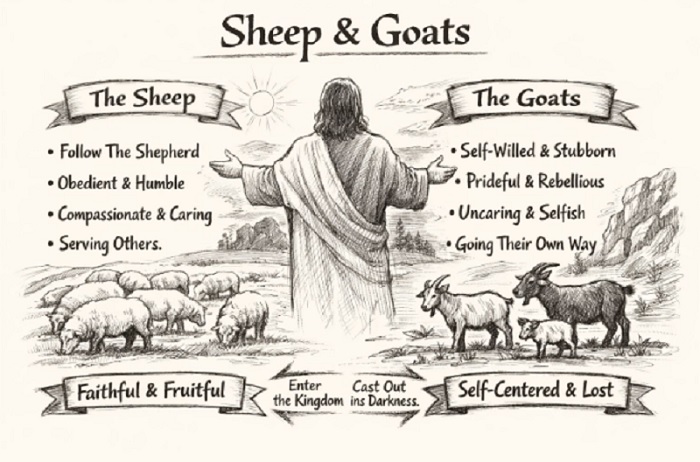
    Matthew 25:31–46: Jesus describes a future day when every nation will stand before Him. Just as a shepherd separates sheep from goats, Christ will separate humanity into two groups: those who belong to Him and those who do not.

    The sheep stand at His right hand and inherit eternal life. The goats stand at His left and face eternal judgment.

    What makes this passage, so striking is that the separation is not based on wealth, education, social status, or religious appearance. Instead, Jesus points to something much deeper—the evidence of a transformed heart.

    The Surprise of the Righteous:
    The King welcomes the sheep with these beautiful words:
    “Come, you who are blessed by my Father; take your inheritance, the kingdom prepared for you since the creation of the world.”

    Then He explains why: they fed the hungry, they gave water to the thirsty, they welcomed strangers, they clothed the needy, they cared for the sick, and they visited those in prison. Surprisingly, the righteous are confused. They ask, “Lord, when did we ever see you hungry, thirsty, sick, or in prison?”

    They were not serving others to gain recognition or earn heaven. Their compassion flowed naturally from hearts that had already been changed by God’s grace. Their acts of mercy were simply the fruit of genuine faith.

    Jesus Is Present Among “The Least of These”:
    Jesus answers with one of the most profound statements in Scripture:
    “Truly I tell you, whatever you did for one of the least of these brothers and sisters of mine, you did for me.” This truth changes how we view people.

    Every hungry person, every lonely widow, every forgotten prisoner, every sick neighbor, every struggling family, and every vulnerable child deserves our attention because Christ identifies Himself with those in need.

    When believers serve others with love, they are serving Christ Himself. The poor are not interruptions to our Christian life—they are opportunities to express Christ’s love.

    The Tragedy of the Goats:
    The goats are equally surprised. They ask Jesus when they failed to help Him. The King replies: “Whatever you did not do for one of the least of these, you did not do for me.” Notice that Jesus does not accuse them of violence, theft, or public rebellion. Their greatest sin is neglect. They ignored suffering. They passed by people in need. They saw opportunities to love but chose comfort instead. Their lack of compassion revealed hearts untouched by God’s transforming grace.

    Does This Mean We Are Saved by Good Works?
    At first glance, someone might think this passage teaches salvation by works. However, the rest of Scripture makes it clear that salvation is God’s gift, received through faith in Jesus Christ.

    The Bible teaches that we are saved by grace through faith—not by our own efforts. Yet genuine faith never remains alone. A living faith naturally produces love, mercy, generosity, and compassion. Good works are not the root of salvation; they are its fruit.

    A healthy tree bears healthy fruit. Likewise, a heart changed by Christ produces a life that reflects His character.

    Compassion Is the Evidence of a Changed Heart:
    Throughout Jesus’ ministry, compassion was never optional. He fed hungry crowds. He touched people affected by leprosy whom society rejected. He welcomed children. He healed the sick. He comforted the broken-hearted. He forgave sinners. If we claim to follow Christ while remaining indifferent to the surrounding suffering, we should honestly examine whether our faith reflects His heart. Christianity is more than attending church, memorizing Scripture, or participating in religious activities. Those things are valuable, but Jesus reminds us that true discipleship is also demonstrated by practical love. Our faith becomes visible when we choose to serve others.

    The Final Judgment Reveals the Heart:
    One of the most remarkable details in this passage is that neither group realizes they have been serving—or neglecting—Jesus.

    The sheep did not keep a record of their good deeds. The goats did not realize the seriousness of their neglect. Their daily choices simply revealed who they truly were.

    On the Day of Judgment, our lives will testify to the reality of our relationship with Christ.

    Living like the Sheep Today
    We may never perform extraordinary miracles or become famous for our faith, but every believer has daily opportunities to reflect Christ.
    A meal shared with someone in need
    A kind word to a lonely neighbour
    Helping a struggling family
    Supporting the poor
    Welcoming the outsider
    These ordinary acts of love become extraordinary when done for the glory of Christ. Every act of mercy offered in Jesus’ name echoes into eternity.

    “Whatever you did for one of the least of these brothers and sisters of mine, you did for me.” — Matthew 25:40

  • STAND FIRM UNTIL THE END

    STAND FIRM UNTIL THE END

    How can believers remain faithful in the last days? Ref. Jude 17–25

    “Dear friends, use your most holy faith to build yourselves up even stronger. Pray with the help of the Holy Spirit. Keep yourselves safe in God’s love, as you wait for the Lord Jesus Christ in his mercy to give you eternal life,” according to Jude 20-21.

    We live in a world where truth is constantly challenged. Right becomes wrong. Wrong becomes acceptable. Faith is mocked, and sin is celebrated.

    The question is not, “Will the world change?” The question is: “How can Christians remain faithful until Jesus returns?”

    The Epistle of Jude gives six instructions to believers.

    I. Remember the Warning (vv. 17–19)
    “Remember what the apostles foretold…” The apostles repeatedly warned about the last days.
    Jesus warned, “Many false prophets will rise…” (Matthew 24). Paul warned, “In the last days perilous times will come…” (II Timothy 3). Peter warned scoffers will come following their own desires (II Peter 3). Jude reminds believers that none of this should surprise us.

    Today’s culture often says: “Follow your heart.” “Live your truth.”

    But Scripture says: Follow Christ.

    Imagine a weather forecast predicting a cyclone. Wise people prepare for it, whereas foolish people ignore it. The apostles gave the Church a spiritual forecast. They told us deception would come. The wise prepare themselves.

    II. Build Yourself Up in Faith (v. 20)
    Faith is like a building. Buildings are not constructed in one day. Every brick matters. Likewise, our faith grows daily.

    How do we build faith?
    By reading Scripture: “Faith comes by hearing…” Romans 10:17. Obey God’s word, fellowship, and worship.

    A tree becomes strong because its roots grow deeper. Storms do not strengthen shallow roots; they expose them. Trials reveal whether our faith has deep roots.

    III. Pray in the Holy Spirit (v. 20)
    Prayer is not merely talking but praying according to God’s will. It is allowing the Spirit to guide our hearts and seek God’s purposes rather than merely our own wishes.

    Jesus often withdrew to pray. If the Son of God needed prayer, how much more do we?

    Prayer is spiritual power. A phone without charging eventually dies. Christians disconnected from prayer lose spiritual strength.

    IV. Keep Yourselves in God’s Love (v. 21)
    Notice carefully. Jude does not say God stops loving us. Rather, we are told to remain in the place where God’s love shapes our lives. Jesus said, “If you keep My commandments, you will abide in My love” (John 15). Love produces obedience.

    Waiting is also part of faith. Jude says we wait for Christ’s mercy. We are not waiting for disaster. We are waiting for Jesus.

    V. Rescue others (vv. 22–23)
    The Christian life is never only about ourselves. Some people doubt; they need compassion and not condemnation. Some believers struggle honestly and need patient answers.

    Jude says, when others are trapped in serious sin, “Snatch them from the fire.” Help them, but do not become entangled in the very sins from which you are trying to rescue them.

    Example: A firefighter enters a burning building wearing protective equipment. He rescues people, but he does not become consumed by the fire. Christians must rescue sinners without embracing sin.

    VI. God’s Power Is Greater Than Our Weakness (vv. 24–25)
    Jude ends not with fear, but with worship. “To Him who is able to keep you from stumbling…” Our security ultimately rests in God. He keeps us. He strengthens us. He presents us faultless through Christ.

    God promises to keep you from falling, present you blameless, fill you with joy, and bring you safely home.

    Salvation begins with grace, continues by grace, and ends in glory.

    Until Jesus’ coming,
    Remember the truth. Grow in faith.
    Pray continually. Remain in God’s love. Rescue others.
    Trust God to keep you.