Blog

  • DIE TO THE OLD LIFE

    DIE TO THE OLD LIFE

    God did not send Christ to renovate your old life. He calls you to die to the old life and live a new life in Christ.” Galatians 2:20 says, “I have been crucified with Christ; it is no longer I who live, but Christ lives in me…”

    CHRIST DID NOT COME TO MAKE THE OLD YOU BETTER
    Imagine buying an old, damaged house. You clean the rooms, repaint the walls, replace the doors, and you put new furniture inside. From the outside, everything looks beautiful. But underneath the paint, the foundation is still broken. That is how many people approach Christianity.

    They say: “I need Jesus so I can become a better person.” So they try to improve: their behaviour, their relationships, or habits. But Christianity is not fundamentally self-improvement. It is death and resurrection.

    Jesus did not come merely to make the old nature comfortable. He came to give us new life. The Gospel is not “Improve yourself.” The Gospel is “Die to yourself and live in Christ.”

    THE OLD SELF CANNOT BE REFORMED
    Romans 6:6 says, “Knowing this, that our old man was crucified with Him…” Notice the language Paul uses. He doesn’t say: “Our old man was educated.” Or “Our old man was improved.” He says: “Our old man was crucified.”

    The problem is the old nature that lives independently of God. He calls us to surrender that old life.

    RELIGION CAN CLEAN THE OUTSIDE — BUT CHRIST CHANGES THE INSIDE
    This is one of the great dangers of Christianity. A person can become religious without becoming transformed. They can attend church, sing songs, or serve in ministry, yet still live according to the old self. Jesus confronted this kind of religion.

    According to Matthew 23:27, Jesus compared religious people to whitewashed tombs. It is a powerful picture which is beautiful outside but dead inside.

    You can change your appearance without changing your heart. You can change your clothes without changing your character. You can change your environment without changing your desires.

    Only Christ can make us new.

    THE CROSS IS NOT DECORATION — IT IS DEATH
    We often wear the cross. We put the cross on the walls. But the biblical cross means something much deeper. The cross represents death. Jesus died on the cross.

    In Galatians 2:20, Paul says: “I have been crucified with Christ and I no longer live, but Christ lives in me. The life I now live in the body, I live by faith in the Son of God, who loved me and gave himself for me.”

    DYING IS NOT A ONE-TIME EMOTION
    Some people have a powerful experience with God. They pray. They cry. They feel God’s presence. But Christian discipleship is not simply about one emotional moment.

    Jesus said, in Luke 9:23, “If anyone desires to come after Me, let him deny himself, and take up his cross daily, and follow Me.”

    YOU CANNOT LIVE THE NEW LIFE WHILE HOLDING ONTO THE OLD LIFE
    Imagine someone trying to walk forward while constantly looking backward. They will eventually stumble.

    Many Christians seek both worldly and spiritual values. But Christ calls us to something different. In Luke 9:62, Jesus said: “No one, having put his hand to the plough, and looking back, is fit for the kingdom of God.”
    Following Jesus requires direction.

    DYING TO THE OLD SELF MEANS CHRIST BECOMES THE CENTER
    Now return to Galatians 2:20: “It is no longer I who live, but Christ lives in me.”
    Christianity isn’t simply: “I am dead.” It is: “I am dead to the old life so that Christ can live through me.” The Christian life is not an empty life. It is a Christ-filled life.

    ZACCHAEUS — A PICTURE OF A CHANGED LIFE
    In Luke 19:1–10, Zacchaeus encounters Jesus. And something changes. He doesn’t simply say: “Jesus, I feel better now.” His encounter with Christ produces repentance. He says he will give to the poor and repay those he has cheated. This is genuine transformation.

    When Christ enters a person’s life, eventually something begins to look different. Not because the person is trying to impress God, but because Christ is changing the person from within.

    THE RICH YOUNG RULER — A CONTRAST
    Now look at another man in Matthew 19:16–22. The rich young ruler comes to Jesus. He appears religious. He has morality. He has possessions. He has status. But when Jesus asks him to surrender what controls his heart, he walks away. This is because he wanted eternal life without surrendering his old life. He wanted Jesus, but he didn’t want Jesus to become Lord over everything.

    And this is the question every Christian must face: “Is Jesus simply part of my life, or is Jesus Lord of my life?”

    HOW DO WE KNOW THE OLD SELF IS DYING?
    It is not by perfection but by direction.

    A Christian may stumble, may fail, or may even struggle. But there should be a growing desire to obey Christ.

    According to Galatians 5:22–23, the fruit of the Spirit produces love, joy, peace, patience, kindness, goodness, faithfulness, gentleness, and self-control. The evidence of new life isn’t the Bible verses we know, but it is the Holy Spirit that is producing a Christ-like character in us.

    THE OLD LIFE HAS TO GO
    Paul gives us a powerful picture in: Ephesians 4:22–24. We are told to: put off the old man, and: put on the new man. Think about changing clothes. You cannot properly put on new clothes while refusing to remove the old ones. Likewise, we cannot continually feed pride, bitterness, lust, greed, hatred, jealousy, and selfish ambition and expect the new life to flourish.

    THE CHRISTIAN LIFE IS DEATH BEFORE RESURRECTION
    There is no resurrection without death. Jesus died and rose again, and Romans 6 connects our identity with that pattern: death to the old and life in Christ. Sometimes God will ask you to let go of something you desperately want. Maybe it is a relationship, a comfortable lifestyle, pride, or a habit. It may feel like death.

    But remember: God never asks you to die to something so He can leave you empty. He calls you to die so that you can live in Christ.

  • The Sheep and the Goats: Serving Christ by Serving Others

    The Sheep and the Goats: Serving Christ by Serving Others

    Serving Christ by serving others means showing God’s love through humble, practical acts of kindness to people in need. Galatians 5:13 says, “My brothers and sisters, God chose you to be free. But don’t use your freedom as an excuse to do what pleases your sinful selves. Instead, serve each other with love.”

    One day, Jesus Christ will return—not as the humble servant born in Bethlehem, but as the glorious King and righteous Judge of all the earth.

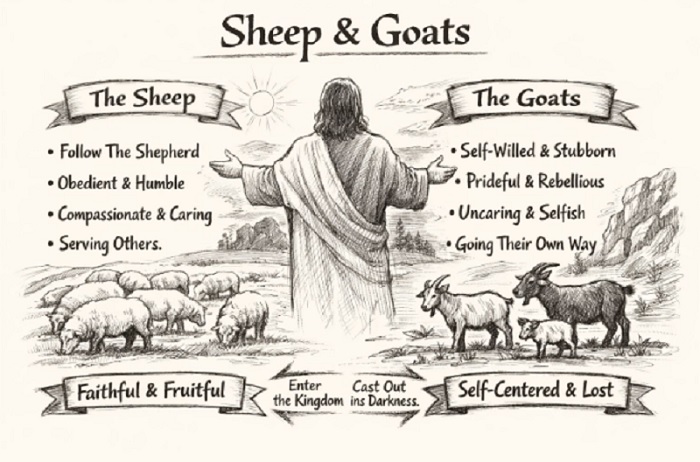
    Matthew 25:31–46: Jesus describes a future day when every nation will stand before Him. Just as a shepherd separates sheep from goats, Christ will separate humanity into two groups: those who belong to Him and those who do not.

    The sheep stand at His right hand and inherit eternal life. The goats stand at His left and face eternal judgment.

    What makes this passage, so striking is that the separation is not based on wealth, education, social status, or religious appearance. Instead, Jesus points to something much deeper—the evidence of a transformed heart.

    The Surprise of the Righteous:
    The King welcomes the sheep with these beautiful words:
    “Come, you who are blessed by my Father; take your inheritance, the kingdom prepared for you since the creation of the world.”

    Then He explains why: they fed the hungry, they gave water to the thirsty, they welcomed strangers, they clothed the needy, they cared for the sick, and they visited those in prison. Surprisingly, the righteous are confused. They ask, “Lord, when did we ever see you hungry, thirsty, sick, or in prison?”

    They were not serving others to gain recognition or earn heaven. Their compassion flowed naturally from hearts that had already been changed by God’s grace. Their acts of mercy were simply the fruit of genuine faith.

    Jesus Is Present Among “The Least of These”:
    Jesus answers with one of the most profound statements in Scripture:
    “Truly I tell you, whatever you did for one of the least of these brothers and sisters of mine, you did for me.” This truth changes how we view people.

    Every hungry person, every lonely widow, every forgotten prisoner, every sick neighbor, every struggling family, and every vulnerable child deserves our attention because Christ identifies Himself with those in need.

    When believers serve others with love, they are serving Christ Himself. The poor are not interruptions to our Christian life—they are opportunities to express Christ’s love.

    The Tragedy of the Goats:
    The goats are equally surprised. They ask Jesus when they failed to help Him. The King replies: “Whatever you did not do for one of the least of these, you did not do for me.” Notice that Jesus does not accuse them of violence, theft, or public rebellion. Their greatest sin is neglect. They ignored suffering. They passed by people in need. They saw opportunities to love but chose comfort instead. Their lack of compassion revealed hearts untouched by God’s transforming grace.

    Does This Mean We Are Saved by Good Works?
    At first glance, someone might think this passage teaches salvation by works. However, the rest of Scripture makes it clear that salvation is God’s gift, received through faith in Jesus Christ.

    The Bible teaches that we are saved by grace through faith—not by our own efforts. Yet genuine faith never remains alone. A living faith naturally produces love, mercy, generosity, and compassion. Good works are not the root of salvation; they are its fruit.

    A healthy tree bears healthy fruit. Likewise, a heart changed by Christ produces a life that reflects His character.

    Compassion Is the Evidence of a Changed Heart:
    Throughout Jesus’ ministry, compassion was never optional. He fed hungry crowds. He touched people affected by leprosy whom society rejected. He welcomed children. He healed the sick. He comforted the broken-hearted. He forgave sinners. If we claim to follow Christ while remaining indifferent to the surrounding suffering, we should honestly examine whether our faith reflects His heart. Christianity is more than attending church, memorizing Scripture, or participating in religious activities. Those things are valuable, but Jesus reminds us that true discipleship is also demonstrated by practical love. Our faith becomes visible when we choose to serve others.

    The Final Judgment Reveals the Heart:
    One of the most remarkable details in this passage is that neither group realizes they have been serving—or neglecting—Jesus.

    The sheep did not keep a record of their good deeds. The goats did not realize the seriousness of their neglect. Their daily choices simply revealed who they truly were.

    On the Day of Judgment, our lives will testify to the reality of our relationship with Christ.

    Living like the Sheep Today
    We may never perform extraordinary miracles or become famous for our faith, but every believer has daily opportunities to reflect Christ.
    A meal shared with someone in need
    A kind word to a lonely neighbour
    Helping a struggling family
    Supporting the poor
    Welcoming the outsider
    These ordinary acts of love become extraordinary when done for the glory of Christ. Every act of mercy offered in Jesus’ name echoes into eternity.

    “Whatever you did for one of the least of these brothers and sisters of mine, you did for me.” — Matthew 25:40

  • STAND FIRM UNTIL THE END

    STAND FIRM UNTIL THE END

    How can believers remain faithful in the last days? Ref. Jude 17–25

    “Dear friends, use your most holy faith to build yourselves up even stronger. Pray with the help of the Holy Spirit. Keep yourselves safe in God’s love, as you wait for the Lord Jesus Christ in his mercy to give you eternal life,” according to Jude 20-21.

    We live in a world where truth is constantly challenged. Right becomes wrong. Wrong becomes acceptable. Faith is mocked, and sin is celebrated.

    The question is not, “Will the world change?” The question is: “How can Christians remain faithful until Jesus returns?”

    The Epistle of Jude gives six instructions to believers.

    I. Remember the Warning (vv. 17–19)
    “Remember what the apostles foretold…” The apostles repeatedly warned about the last days.
    Jesus warned, “Many false prophets will rise…” (Matthew 24). Paul warned, “In the last days perilous times will come…” (II Timothy 3). Peter warned scoffers will come following their own desires (II Peter 3). Jude reminds believers that none of this should surprise us.

    Today’s culture often says: “Follow your heart.” “Live your truth.”

    But Scripture says: Follow Christ.

    Imagine a weather forecast predicting a cyclone. Wise people prepare for it, whereas foolish people ignore it. The apostles gave the Church a spiritual forecast. They told us deception would come. The wise prepare themselves.

    II. Build Yourself Up in Faith (v. 20)
    Faith is like a building. Buildings are not constructed in one day. Every brick matters. Likewise, our faith grows daily.

    How do we build faith?
    By reading Scripture: “Faith comes by hearing…” Romans 10:17. Obey God’s word, fellowship, and worship.

    A tree becomes strong because its roots grow deeper. Storms do not strengthen shallow roots; they expose them. Trials reveal whether our faith has deep roots.

    III. Pray in the Holy Spirit (v. 20)
    Prayer is not merely talking but praying according to God’s will. It is allowing the Spirit to guide our hearts and seek God’s purposes rather than merely our own wishes.

    Jesus often withdrew to pray. If the Son of God needed prayer, how much more do we?

    Prayer is spiritual power. A phone without charging eventually dies. Christians disconnected from prayer lose spiritual strength.

    IV. Keep Yourselves in God’s Love (v. 21)
    Notice carefully. Jude does not say God stops loving us. Rather, we are told to remain in the place where God’s love shapes our lives. Jesus said, “If you keep My commandments, you will abide in My love” (John 15). Love produces obedience.

    Waiting is also part of faith. Jude says we wait for Christ’s mercy. We are not waiting for disaster. We are waiting for Jesus.

    V. Rescue others (vv. 22–23)
    The Christian life is never only about ourselves. Some people doubt; they need compassion and not condemnation. Some believers struggle honestly and need patient answers.

    Jude says, when others are trapped in serious sin, “Snatch them from the fire.” Help them, but do not become entangled in the very sins from which you are trying to rescue them.

    Example: A firefighter enters a burning building wearing protective equipment. He rescues people, but he does not become consumed by the fire. Christians must rescue sinners without embracing sin.

    VI. God’s Power Is Greater Than Our Weakness (vv. 24–25)
    Jude ends not with fear, but with worship. “To Him who is able to keep you from stumbling…” Our security ultimately rests in God. He keeps us. He strengthens us. He presents us faultless through Christ.

    God promises to keep you from falling, present you blameless, fill you with joy, and bring you safely home.

    Salvation begins with grace, continues by grace, and ends in glory.

    Until Jesus’ coming,
    Remember the truth. Grow in faith.
    Pray continually. Remain in God’s love. Rescue others.
    Trust God to keep you.

  • Nathanael: A Man with No Deceit

    Nathanael: A Man with No Deceit

    The character that earned Jesus’s commendation
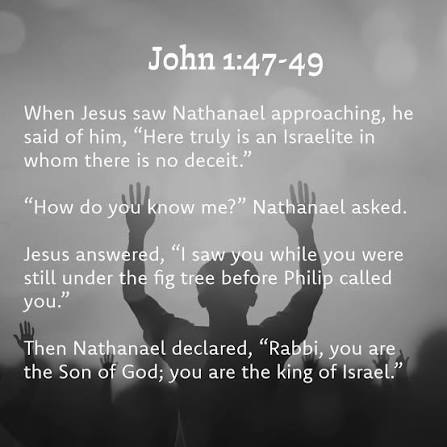
    Nathanael was an honest skeptic from Cana who moves from doubt to faith after Jesus reveals He saw him under a fig tree. He was transparent before God. His words reflected his heart. His actions matched his beliefs. He lived honestly before God and others.

    John 1:47, “Jesus saw Nathanael coming toward Him and said of him, ‘Behold, an Israelite indeed, in whom is no deceit!’”

    This was more than a compliment. It was a testimony from the Son of God about the condition of Nathanael’s heart. Jesus looked beyond appearances and saw a man of honesty, sincerity, and integrity.

    In a world where deception is often accepted and hypocrisy is common, Nathanael stands as a powerful example of the kind of character that pleases God.

    Jesus Perceives the Inner Being.
    People often judge others by outward appearances. We admire success, intelligence, influence, or popularity. However, Jesus looks deeper. He sees our thoughts, motives, and intentions. He knows who we are when no one else is watching.

    When Jesus looked at Nathanael, He did not see a perfect man. He saw a genuine man—a person whose heart was free from deceit. This reminds us that God is more concerned about our character than our reputation.

    Why did Jesus call Nathanael “an Israelite indeed?”
    This phrase is significant because it points beyond Nathanael’s ancestry to his character. The name Israel belongs to Jacob, whose early life was marked by deception. Jacob even obtained his father’s blessing by disguising himself as his brother. Yet after encountering God, Jacob was transformed and became Israel.

    By calling Nathanael “an Israelite indeed, in whom is no deceit,” Jesus highlighted the contrast. Nathanael reflected the transformed character God desired, not the deceptive nature associated with Jacob’s earlier life. He was a true worshipper whose faith was sincere.

    Nathanael was honest enough to change
    One of the most beautiful qualities of Nathanael is his willingness to accept the truth. When Philip told him that they had found the Messiah from Nazareth, Nathanael responded honestly: “Can anything good come out of Nazareth?” (John 1:46)

    Some people criticize Nathanael for this question, but it actually reveals his sincerity. He spoke honestly instead of pretending to know what he did not understand. More importantly, when he encountered Jesus and recognized who He was, Nathanael immediately changed his perspective.

    He confessed, “Rabbi, You are the Son of God! You are the King of Israel!” (John 1:49)

    A sincere heart is always willing to follow the truth wherever it leads.

    Integrity in a world of deception is very important.
    We live in a culture where appearances often matter more than reality. People carefully manage their public image while hiding private struggles. Politicians make empty promises. Social media encourages carefully edited versions of life. Even Christians can fall into the trap of appearing spiritual while neglecting genuine devotion to God.

    Nathanael reminds us that God values authenticity over performance. He desires disciples who are truthful in speech, faithful in conduct, and sincere in worship.

    How Can We Live Without Deceit?
    Nathanael’s example challenges every believer to pursue integrity in daily life. Living without deceit means choosing honesty even when dishonesty seems easier. It means confessing sin instead of covering it up. It means serving God with a pure heart rather than seeking recognition.

    What is the blessing of a pure heart?
    God always honors those who walk in integrity. A truthful heart enjoys peace because it has nothing to hide. Integrity builds trust in relationships. Honesty strengthens our witness before the world. Most importantly, a sincere heart delights the Lord. Jesus’ words about Nathanael remind us that heaven celebrates character more than accomplishments.

    The world admires talent, success, wealth, and influence. Jesus admired something far greater. He admired a heart without deceit. Nathanael’s legacy is not built on miracles, sermons, or public achievements. It is built on integrity. His sincerity was so evident that the Son of God praised him before others.

    May we pursue the same kind of character. May our lives reflect honesty, humility, and authenticity. And may we live in such a way that, if Jesus were to speak about us, He could also say: “Behold, a true disciple, in whom is no deceit.”