Blog

  • You Cannot Serve Both God and Money

    You Cannot Serve Both God and Money

    We live in a world where success is often measured by wealth, possessions, and financial status. Everywhere we look, we are encouraged to earn more, buy more, and accumulate more. Money has become more than a tool—it has become a master for many.

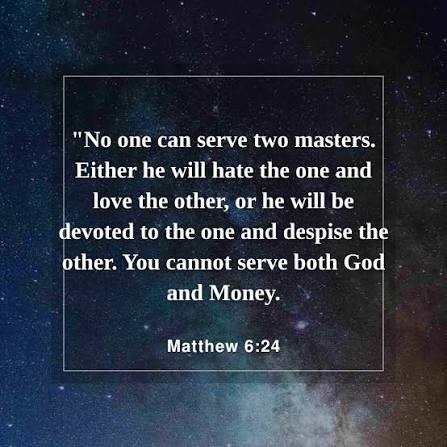
    Yet Jesus makes a powerful and uncompromising statement: “No one can serve two masters… You cannot serve both God and money.” (Matthew 6:24)

    This is not merely a warning about wealth. It is a question about lordship. Who is truly ruling your heart?

    Money Is a Good Servant but a Terrible Master
    The Bible never teaches that money itself is evil. Money can provide for families, support ministries, feed the poor, and advance God’s kingdom. The problem begins when money moves from our hands into our hearts.

    What happens when money becomes our master: Decisions are driven by profit instead of principle. Relationships become less important than success. Time with God is sacrificed for career advancement. Generosity is replaced by greed. Security is found in bank accounts instead of God’s promises.

    Jesus knew that the greatest competitor for human devotion would not be another religion—it would often be wealth.

    Let’s see how two masters demand total loyalty.
    Jesus says no one can serve two masters because each master demands complete allegiance.

    When we serve God, we seek His kingdom first. We trust Him for our daily needs. We value people over possessions. We pursue righteousness instead of riches. We use money as a tool to glorify God.

    Serving God produce: Peace, Contentment, Generosity, Integrity and Eternal rewards

    When we serve money, money becomes our master. We constantly worry about having enough. Success becomes our identity. We compromise biblical values for financial gain. We compare ourselves with others. We never feel satisfied because there is always more to chase.

    Serving money produce: Anxiety, Greed, Pride, Envy, and Spiritual emptiness

    In Luke 18 and 19 chapters we see contrasting the rich young ruler and Zacchaeus highlights two opposite responses to Jesus regarding wealth and surrender

    Rich Young Ruler Relies on his own good deeds. Refuses to give up his great wealth when Jesus asks him to, walking away sad but Zacchaeus humbled himself by climbing a tree to see Jesus. He voluntarily gives half his money to the poor and pays back four times what he stole.

    We should find out where our treasure is. As Jesus said, “For where your treasure is, there your heart will be also.” (Matthew 6:21)
    Ask yourself: What consumes my thoughts? What am I unwilling to surrender? What gives me my sense of security? These questions expose the true master of our hearts.

    Practical ways to keep God first: Begin every financial decision with prayer. Practice generosity regularly. Live with contentment rather than constant comparison. Remember that everything belongs to God. Invest not only in earthly wealth but also in eternal treasures.

    Money promises happiness but cannot satisfy the soul. Money promises security but cannot guarantee tomorrow. Money promises importance but cannot purchase eternal life. Only Jesus offers forgiveness, peace, purpose, and eternal hope.

    Here, the question is, “Do you have money?”, or “Does money have you?”
    God is not asking us to hate money. He is asking us not to worship it. Money should remain a servant in our hands—not a master over our hearts.

    Every day we choose whom we will serve. One master leads to endless striving. The other leads to abundant life. May we echo the words of Joshua: “As for me and my house, we will serve the Lord.” (Joshua 24:15). Because when God is your Master, money becomes your servant—and your heart discovers a treasure that neither moth nor rust can destroy.

  • REPENT OR PERISH

    REPENT OR PERISH

    What is Repentance?
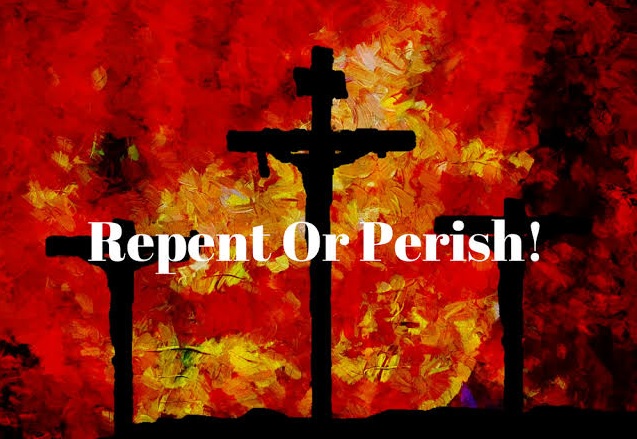
    Repentance is a complete change of mind, heart, and direction that results in a change of action. It is turning away from sin and turning towards Christ. It is like a narrow path illuminated by the light of the cross, while a wide road disappears into darkness, or a person making a U-turn from a dark road towards a brightly lit cross.

    Why did Jesus say in Luke 13:5, “I tell you, no; but unless you repent you will all likewise perish?”
    People asked Jesus about tragedies, as they believed those who died must have been worse sinners. So, Jesus corrected them, saying, “Don’t judge others. Examine your heart.”

    Everyone needs repentance. Why?
    Romans 3:23 states: “For all have sinned and fall short of the glory of God” (ESV). Every human being has disobeyed God and lacks the moral perfection required to meet His holy standard. No one is excluded, whether they are rich, poor, religious, young, or old.

    – Why do you have to repent?
    Sin separates us from God. Sin destroys lives. Sin leads to death. Romans 6:23 states: “For the wages of sin is death, but the gift of God is eternal life in Christ Jesus our Lord.”

    – What True Repentance Looks Like
    True repentance produces change from an old life of pride, anger, lies, bitterness, and immorality into a new life of humility, love, truth, forgiveness, and holiness.

    – Why repentance is immediate
    Jesus repeats, “Unless you repent…” meaning tomorrow is uncertain. Hebrews 9:27 says, “And just as it is appointed for man to die once, and after that comes judgment.”

    – How is God’s mercy shown in repentance?
    God doesn’t desire destruction. He desires repentance. 2 Peter says, “The Lord is…not willing that any should perish.” God waits because He loves him.

    – How is the barren fig tree related to this context?
    Luke 13:6–9 describes the parable of the barren fig tree, in which the owner of the vineyard has spent time and energy caring for his fig tree. He expected some fruit, but the tree is barren.

    God mercifully gives people a second chance. God seeks fruit—not merely leaves.

    – What are the fruits worthy of repentance?
    According to Galatians 5:22–23, the fruit of the Spirit is love, joy, peace, forbearance, kindness, goodness, faithfulness, gentleness, and self-control. Against such things there is no law.

    “Unless you repent, you will all likewise perish.” (Luke 13:5)

    Repentance is not God’s punishment. Repentance is God’s invitation to come home.

  • My Dream: A Call from God

    My Dream: A Call from God

    My Dream: A Call from God (A testimony from my sister)

    Dreams have always been one of the most mysterious and profound ways God speaks to us. Sometimes, they may seem ordinary at first, but when we look back, we realize they were full of divine meaning. I had one such dream – a dream that reminded me of God’s presence, His timing, and His calling for my family.

    It began in a simple yet strange way. In my dream, I heard my mother’s voice. But when I looked closer, it wasn’t her speaking – it was my friend’s three-month-old daughter. Through the child’s lips came my mother’s voice saying, “Everyone come together on 25th July, I will come.” I woke up puzzled and shared the dream with one of my sisters, but we didn’t dwell on it much. Life went on as usual.

    Days later, my sister and I began talking about how nice it would be for all of us siblings to come together and study the Bible. I felt like a sudden inspiration – something that came to both of us naturally. As we planned, we decided on a date for our first meeting. The date we chose, without realizing it, was 25th July. The moment I noticed the date, my heart filled with awe. The dream came rushing back to me. I understood that it wasn’t just a random thought or coincidence – it was His way of bringing our family closer, not just to one another but to Him.

    That dream changed the way I look at God’s communication. I learned that he speaks in the simplest, most unexpected ways. It reminded me that when we remain open and faithful, God reveals His purpose in His perfect time.

    July 25th will always be a special date for me – a day when God called my family together to seek Him and walk in His light. Since that day, July 25th 2020, we have continued to gather for Bible study every Saturday.

  • Profane Talking and Old Wives fables

    Profane Talking and Old Wives fables

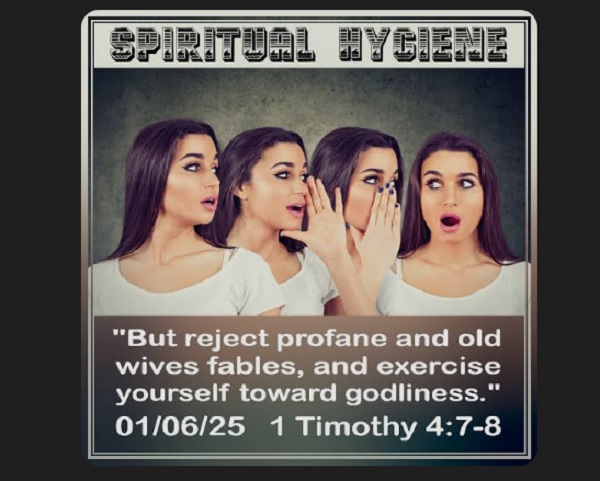
    Profane talking means treating sacred things without respect through behaviour or rude language. Sometimes, profane talking might become very dangerous because a small spark can burn an entire forest—so can one careless word destroy peace?

    What are the effects of profane talking?
    Words reveal the heart (Luke 6:45)
    Words can destroy lives and relationships.
    Words grieve the Holy Spirit

    According to Ephesians 4:29 — “Let no corrupt communication proceed out of your mouth…”

    Old wives’ tales: Old wives’ tales are superstitious beliefs such as blind belief in luck, omens, or rituals; viral misinformation presented as “truth” and feel-good teachings without a biblical foundation.

    What are the effects of old wives’ tales?
    We get distracted from the truth
    We create fear or confusion
    We replace faith with superstition

    According to 1st Timothy 4:7 — “Have nothing to do with godless myths and old wives’ tales…”

    How do we overcome old wives’ fables and profane talking?
    Speak words that build, not break. Think before speaking: Is it true? Is it helpful? Is it godly? Test everything with Scripture and stay rooted in truth, not trends.

    1 Timothy 4:7–8 — describes “…train yourself to be godly.”
    You cannot speak godly words if your mind is filled with ungodly input. James 3:5–6 — emphasizes the tongue is small but powerful.

    Spiritual discipline for profane talking and old wives’ fables includes:
    Controlling your speech
    Filling your mind with truth
    Pursuing truth and godliness

    After transformation, what is the power of the tongue?
    Your speech becomes life-giving, your words reflect Christ, and your influence becomes positive.